

RFK Jr Peptide Announcement February 2026: Full Breakdown

On February 27, 2026, something significant happened during Episode 2461 of The Joe Rogan Experience.
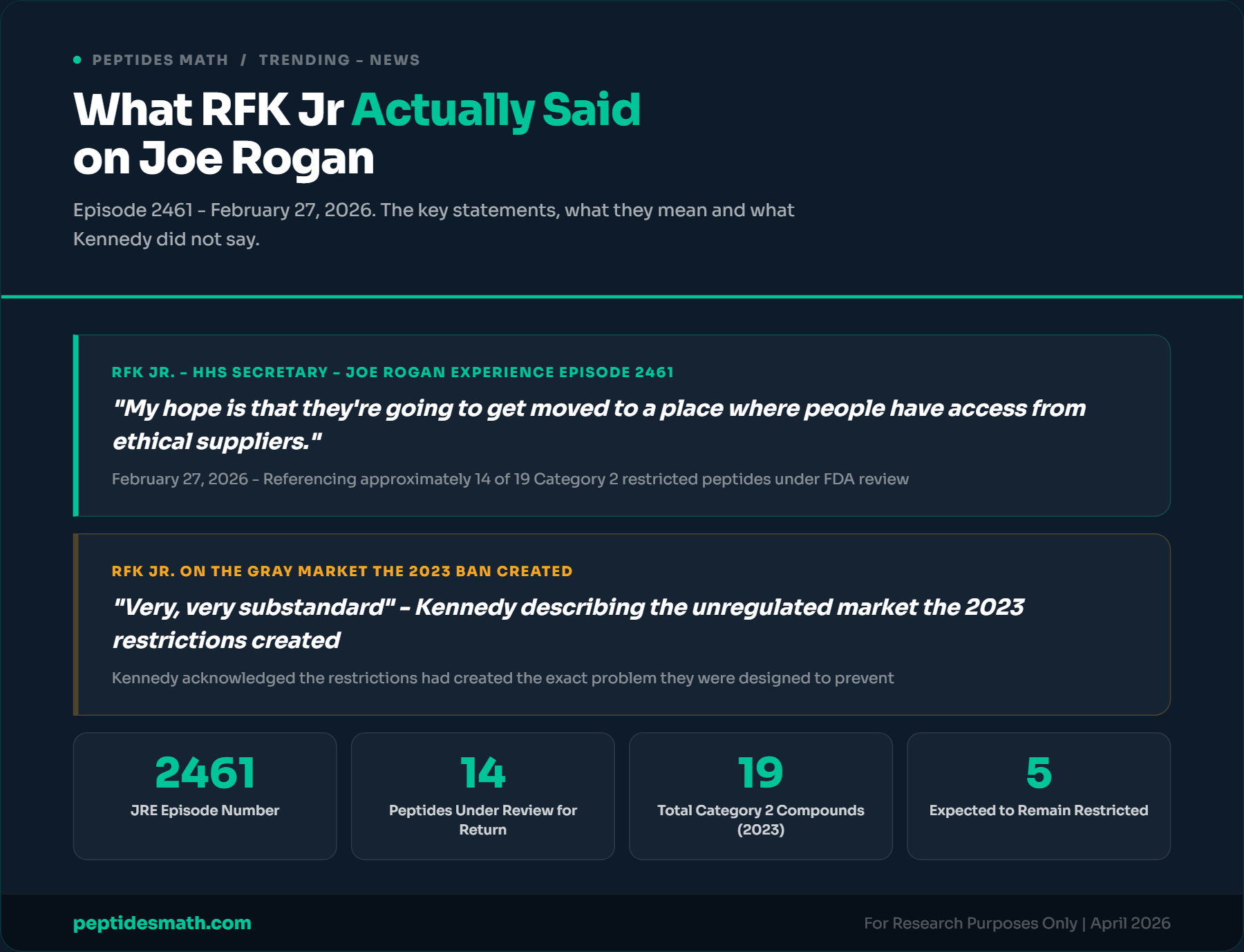
Sitting across from Joe Rogan, HHS Secretary Robert F. Kennedy Jr. announced that the FDA was reviewing approximately 14 of the 19 peptides currently on its Category 2 restricted list, and that he expected an announcement within a couple of weeks.
That statement sparked one of the largest waves of discussion in the peptide research community in years. Social media lit up. Clinics started fielding calls. Research communities went into a frenzy trying to parse exactly what Kennedy said and what it actually means.
This article cuts through the noise. We cover exactly what Kennedy said, what authority HHS actually has over FDA decisions, which peptides are affected, what researchers need to know right now, and what the realistic timeline looks like.
- On February 27, 2026, HHS Secretary RFK Jr. announced on The Joe Rogan Experience (Episode 2461) that approximately 14 of 19 Category 2 peptides are expected to return to legal compounding status
- Kennedy described himself as a ‘big fan’ of peptides and stated his hope that they ‘end up in a place where people have access to ethical suppliers.
- The announcement was a policy signal, not a formal regulatory action. No FDA rule changed on that date
- Kennedy acknowledged that the 2023 restrictions created a gray market that was ‘very, very substandard.
- The formal FDA updated 503A list was finalized as of April 2026
- Joe Rogan himself vouched for BPC-157 on the podcast, saying it resolved his elbow tendonitis in two weeks
- A legal challenge arguing the FDA lacked sufficient safety signal data for the 2023 restrictions was a key factor in driving the review
- Compounding pharmacy supply chains may take months to ramp up, even after formal reclassification
What RFK Jr Actually Said on Joe Rogan
The February 27, 2026, Joe Rogan Experience episode was wide-ranging. Kennedy covered topics from vaccine policy to food regulation to the structure of federal health agencies.
The peptide discussion came up organically. Rogan, a known BPC-157 advocate who had previously discussed peptides on his show, raised the topic directly.
The Exact Statements
Kennedy told Rogan that the FDA was ‘in the middle of’ reviewing the Category 2 list, and that within ‘a couple of weeks’ he hoped there would be an announcement. He expressed his personal view that the compounds should ‘end up in a place where people have access to ethical suppliers.’
He described himself as a ‘big fan’ of peptides and characterized the prior administration’s handling of the restrictions as regulatory overreach unsupported by adequate safety evidence.
Kennedy also called out the gray market that the restrictions had created. He described the unregulated peptide supply chain as ‘very, very substandard’ and said consumers often ‘have no idea’ what is in the products they are obtaining from unregulated online vendors.
What Kennedy Did Not Say
Kennedy did not announce a formal regulatory action on the podcast. He did not name all 14 peptides specifically. He did not issue a Federal Register notice. He did not change any FDA rule.
This distinction matters because, within days of the episode airing, social media was filled with claims that peptides were ‘legal again’ and that restrictions had been lifted. None of that was accurate at the time of the podcast.
The FDA regulatory process for modifying the 503A bulk drug substances list involves a formal procedure with public comment periods, advisory committee review, and official publication. A podcast statement from the HHS Secretary, however influential, does not substitute for that process.
Joe Rogan’s Personal Advocacy
Rogan added his own weight to the discussion. He told his audience that he had used BPC-157 for elbow tendonitis and that it resolved within two weeks. Rogan has one of the largest podcast audiences in the world, with over 20 million listeners per episode. His personal endorsement of BPC-157 on the same episode where Kennedy announced the policy review contributed significantly to the subsequent explosion in public interest.
Why Kennedy Pushed for This Change
The February 2026 announcement did not come out of nowhere. It was the result of a months-long campaign by compounding pharmacy trade groups, functional medicine clinicians, and patient advocates who argued the FDA had overreached in 2023.
The 2023 Restrictions and Their Aftermath
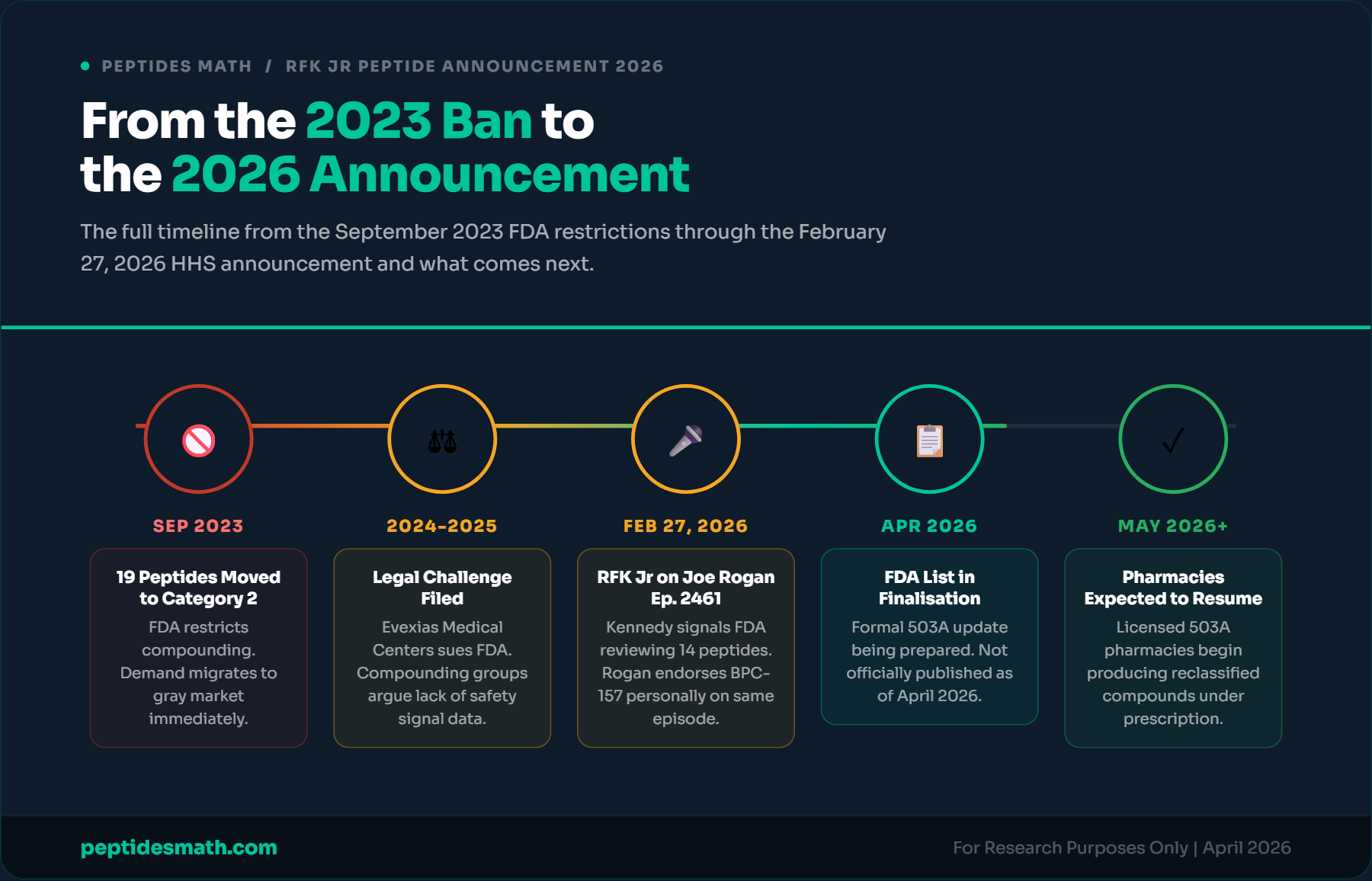
In September 2023, the FDA moved 19 popular peptide compounds to its Category 2 bulk drug substances list. The practical effect was immediate: licensed compounding pharmacies across the United States were required to stop preparing these compounds for patients.
The FDA cited concerns about safety data, immunogenicity risk, and peptide-related impurities. Critics argued that the evidence threshold the agency applied was inconsistent with how it had treated other compound categories and that no specific safety signal had triggered the restrictions for most of the 19 compounds.
The Gray Market Problem
The restriction did exactly what its critics predicted: demand did not decrease; it migrated. Online vendors began selling the same peptide compounds labeled as research-use-only products. These vendors operated outside the pharmaceutical regulatory framework with no sterility requirements, no purity testing standards, and no physician oversight.
NPR reported in March 2026 that the gray market was ‘running amok’ according to Scott Brunner, CEO of the Alliance for Pharmacy Compounding. Dr. Myles Spar, an integrative medicine specialist, noted that people were injecting themselves with substances where they did not know what was inside the vial.
Kennedy himself acknowledged this dynamic directly in the Rogan interview. The restrictions had created the very problem they were designed to prevent.
The Legal Challenge
A lawsuit filed by Evexias Medical Centers against the FDA argued that the agency had exceeded its authority in placing certain peptides on the Category 2 list. Kennedy referenced the case during the Rogan interview to explain why the FDA was now reviewing its position.
According to legal analysis from Frier Levitt, an FDA law firm, several peptides, including CJC-1295, Ipamorelin, Thymosin Alpha-1, AOD-9604, and Selank, had their compounding nominations withdrawn and went through advisory committee review. In each case, the FDA recommended against inclusion in the approved list, and the Pharmacy Compounding Advisory Committee (PCAC) voted against inclusion. Those same peptides became the subject of renewed legal pressure.
What Authority Does HHS Have Over FDA Peptide Decisions
One of the most important questions the February 2026 announcement raised was simple: Can the HHS Secretary actually make this happen?
The answer requires understanding where HHS authority ends and where the formal FDA regulatory process begins.
The HHS Secretary and the FDA
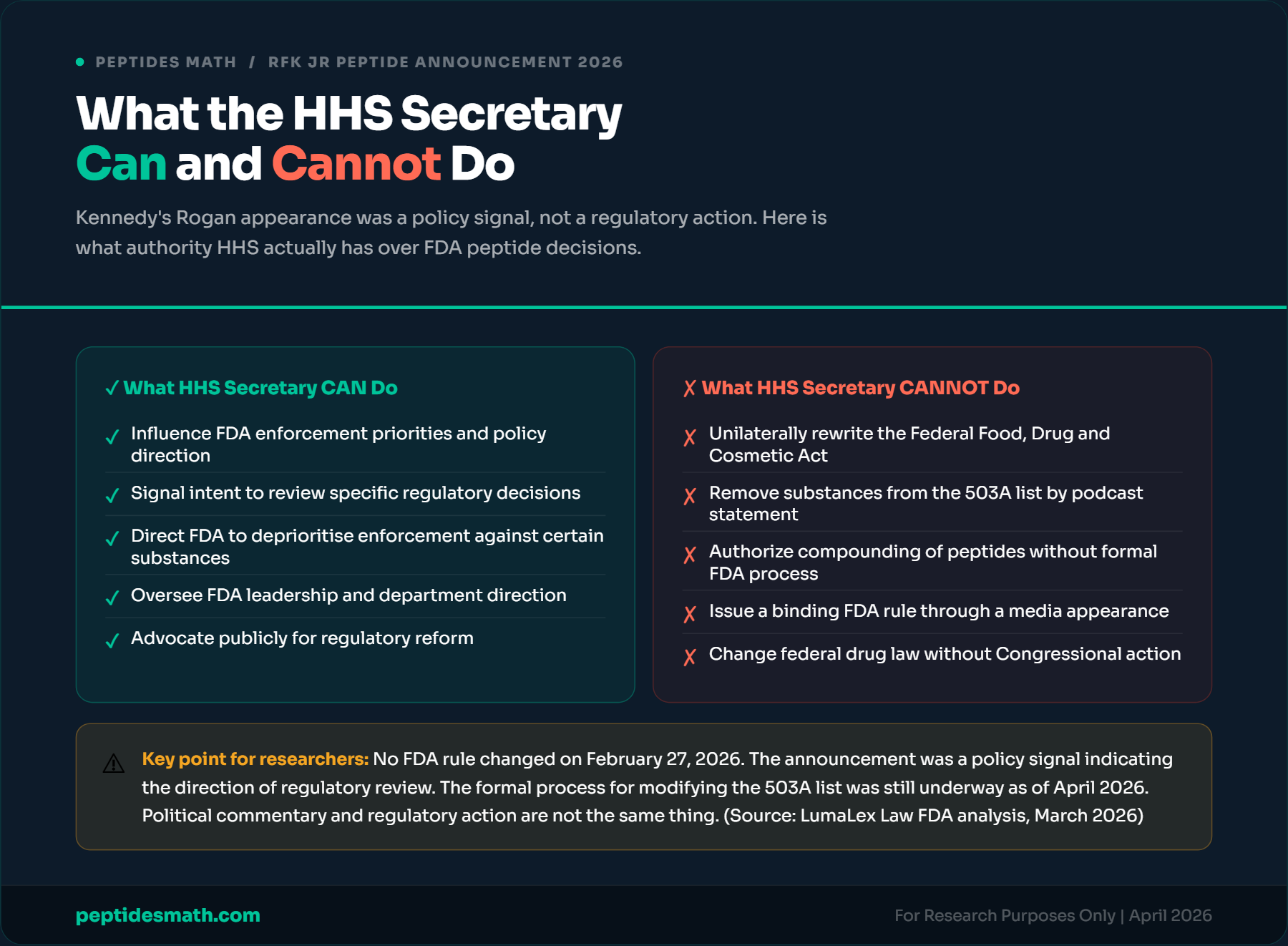
The FDA is part of the Department of Health and Human Services. The HHS Secretary oversees the FDA and can influence policy direction and enforcement priorities. Kennedy’s role gives him significant influence over which issues the FDA prioritizes and how aggressively it enforces existing rules.
However, the HHS Secretary cannot unilaterally rewrite federal drug law. The Federal Food, Drug, and Cosmetic Act defines how the FDA regulates compounded medications. Changing which substances appear on the 503A bulk drug list requires a defined regulatory process.
How the 503A List Actually Changes
For a peptide to move from Category 2 to Category 1, the FDA would need to formally update the bulk drug substances list through one of several pathways:
- Formal rulemaking through the Federal Register with a public comment period
- Administrative action removing specific substances from the Category 2 list based on a new safety data review
- Enforcement discretion: the FDA deprioritizes enforcement against certain substances without formally changing the rule
- Congressional action amending the underlying statute
Kennedy’s announcement pointed toward option 2 or 3. His language about an announcement ‘within a couple of weeks’ suggested an administrative action rather than a full rulemaking process, which typically takes months to years.
What LumaLex Law Said
FDA law firm LumaLex Law published a clear-eyed analysis noting that as of the date of the Rogan interview, no FDA rule had changed. No Federal Register notice had been issued. No substances had been removed from Category 2. The firm emphasized that ‘political commentary and regulatory action are not the same thing.’
This is an important point for researchers to understand. The HHS announcement was a signal of intent and direction. The formal legal change requires additional steps that were in progress as of April 2026.
The 14 Peptides Expected to Return to Legal Compounding
Kennedy did not name all 14 peptides specifically during the Rogan interview. The list of expected compounds is based on analyses by compounding pharmacy associations, FDA law firms, and regulatory experts who cross-referenced Kennedy’s statements with the existing Category 2 list and the history of legal challenges.
Based on the February 2026 announcement and analysis from multiple regulatory sources, these are the compounds expected to return to Category 1:
- BPC-157 (Body Protection Compound-157) – studied for tissue repair, gut healing, and recovery. One of the most researched peptides in the Category 2 list. Kennedy’s announcement and Rogan’s personal endorsement brought this compound the most mainstream attention.
- TB-500 / Thymosin Beta-4 Fragment – studied for muscle repair, tissue recovery, and wound healing. Widely used in research settings before the 2023 restrictions.
- Thymosin Alpha-1 – an immune-modulating peptide that is approved as a pharmaceutical product in more than 30 countries for hepatitis B, hepatitis C, and immune support in oncology applications. This compound had the most human clinical data of any on the Category 2 list.
- CJC-1295 – a growth hormone-releasing hormone analog studied for metabolic and recovery applications. Was part of the advisory committee review process prior to Kennedy’s announcement.
- Ipamorelin Acetate – a growth hormone secretagogue studied for sleep quality, metabolism, and lean muscle. Also went through advisory committee review.
- AOD-9604 – a peptide fragment studied for fat metabolism and weight research.
- Selank Acetate – a neuropeptide studied for cognitive function and anxiety. Went through advisory committee review.
- Semax – a neuropeptide studied for cognitive enhancement and neuroprotection.
- KPV – an anti-inflammatory peptide with studied gut health applications.
- MOTS-C – a mitochondrial peptide studied for metabolic regulation and energy metabolism.
- GHK-Cu (injectable) – a copper peptide studied for wound healing, tissue regeneration, and skin applications.
- DSIP (Emideltide) – a delta sleep-inducing peptide studied for sleep regulation.
- Kisspeptin-10 – studied for hormonal regulation and reproductive health research.
- GHRP-6 – a growth hormone-releasing peptide studied for GH secretion and appetite regulation.
The 5 Compounds Expected to Stay Restricted
Five compounds from the original Category 2 list are expected to remain restricted. These are the compounds the FDA identified as having the most significant unresolved safety concerns:
- LL-37 – antimicrobial peptide with unresolved safety data questions
- Melanotan II – tanning peptide with safety concerns around off-label use patterns
- PEG-MGF – mechano growth factor with unresolved immunogenicity concerns
- GHRP-2 – Kennedy himself referenced adverse events, including deaths, linked to GHRP-2 during the Rogan interview, making this one of the clearest cases for remaining on Category 2
- Epitalon – an anti-aging bioregulator with insufficient compounding safety data
What the RFK Jr Announcement Means for Researchers
The February 2026 announcement has different practical implications depending on how you work with peptide compounds in your research.
Research-Only Vendor Sources Are Not Affected
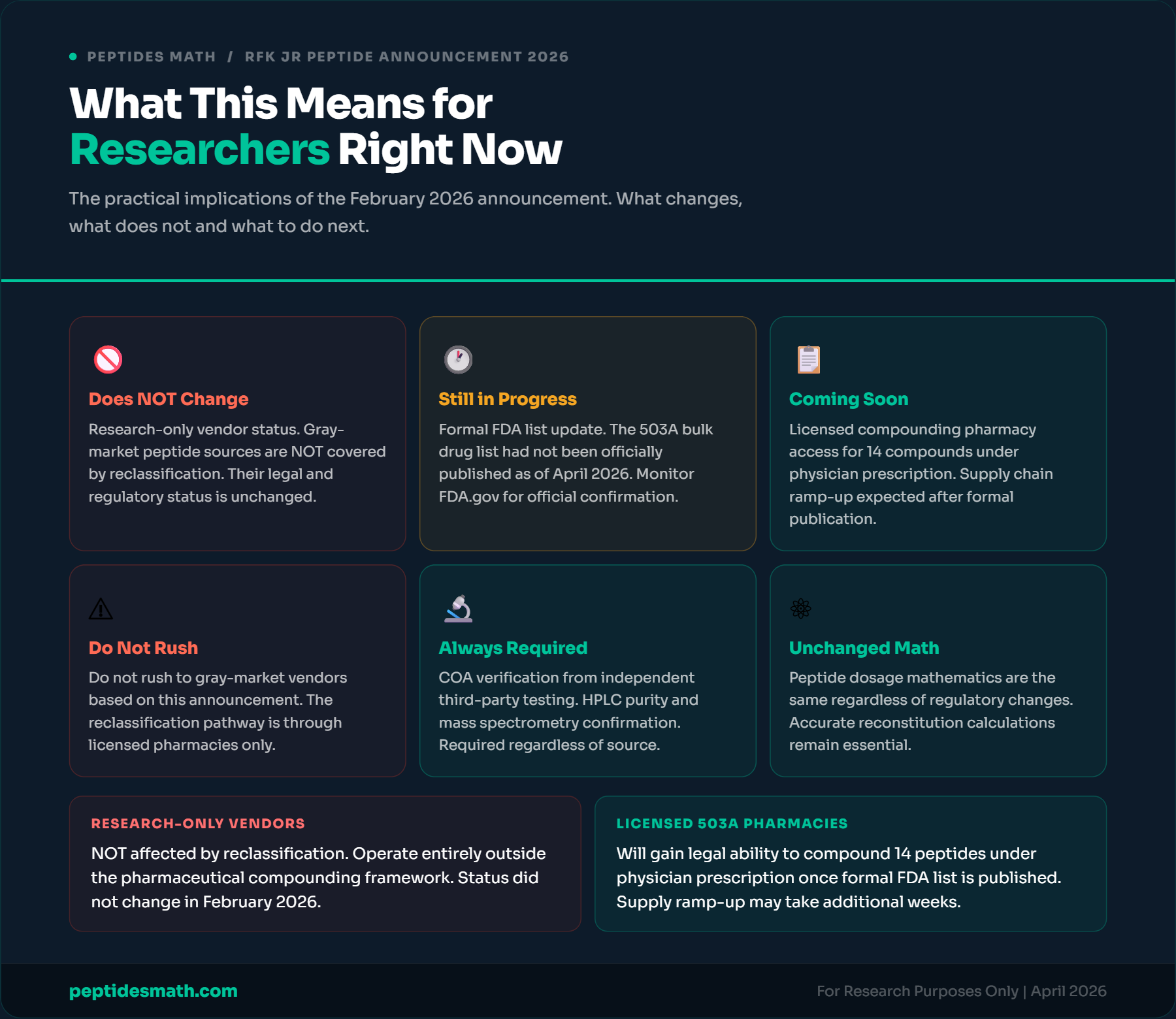
This is the most important point for most researchers to understand. The reclassification, when formalized, creates a legal pathway for a physician’s prescription through licensed 503A compounding pharmacies.
Research-only vendors selling peptides for laboratory use operate in a completely separate space. Their products are not pharmacy-compounded preparations. The reclassification from Category 2 to Category 1 does not change the regulatory status of research-chemical vendors.
If you currently source compounds from research-only vendors, the February 2026 announcement changes nothing about your specific sourcing situation.
Supply Chain Will Take Time to Ramp Up
Even after the formal FDA list update is published, researchers and clinicians expecting immediate access through compounding pharmacies face a practical delay. Scott Brunner of the Alliance for Pharmacy Compounding noted that pharmacies will need to stock up on pharmaceutical-grade raw ingredients before they can resume production.
The supply chain ramp-up could take months after the formal announcement. Brunner warned that there could be a situation in which prescribers and patients rush to their compounding pharmacy, only to be frustrated by unavailability.
Verify COA Documentation Regardless of Source
Whether you source through a compounding pharmacy or a research-only vendor, the most important quality control step remains the same: verify the Certificate of Analysis from an independent third-party testing laboratory.
COA documentation should show HPLC purity testing results, mass spectrometry confirmation of compound identity, and sterility testing where applicable. A compound sourced from a licensed compounding pharmacy with USP 797 standards does not automatically guarantee quality without COA verification.
Accurate Dosage Calculations Remain Essential
The regulatory environment around peptides is changing. The mathematics of peptide reconstitution and dosage calculation are not. Whether you are working with BPC-157, Thymosin Alpha-1, CJC-1295, or any other compound on the expected return list, accurate syringe unit calculations are essential for research consistency.
What is the Realistic Timeline for Formal Reclassification
Kennedy said ‘a couple of weeks’ on February 27, 2026. As of April 2026, the formally updated FDA list had not yet been published. Here is the realistic timeline based on the regulatory process involved.
February 27, 2026 – The Rogan Announcement
Kennedy signals the reclassification during Episode 2461 of The Joe Rogan Experience. No formal regulatory action was taken on this date.
March 2026 – Regulatory Preparation
FDA begins internal review of the 503A bulk drug substances list. Industry analysis and legal commentators begin parsing which specific peptides are most likely to move. Compounding pharmacy groups begin preparing supply chains.
April 2026 – List in Finalization
As of the time of writing, the formal FDA updated list was in the finalization process. No official Federal Register notice had been published. The regulatory change was expected imminently.
May 2026 and Beyond – Expected Implementation
Licensed compounding pharmacies are expected to begin producing reclassified peptides for patients with valid physician prescriptions. Supply chain ramp-up may take additional weeks or months as pharmacies source pharmaceutical-grade raw ingredients.
Why It Took Longer Than Kennedy Suggested
Kennedy’s ‘couple of weeks’ timeline was optimistic. Federal administrative law processes do not move at the speed of podcast timelines. Even with HHS Secretary-level support, the formal process for modifying the 503A list involves internal FDA review, legal verification, and formal publication steps that cannot be compressed below a certain minimum timeline.
What Researchers Should Do Right Now
Do Not Rush to Gray-Market Sources Based on This Announcement
The Category 1 reclassification creates a pathway for prescription use through licensed compounding pharmacies. It does not legitimize or regulate the research-chemical vendor market. Gray-market vendors remain unregulated regardless of Kennedy’s announcement.
Monitor the Official FDA 503A Page
The formal updated list will be published on the FDA’s Bulk Drug Substances page. Check this page for the official status update rather than relying on social media or news coverage.
Verify COA Documentation
Third-party Certificate of Analysis documentation from an independent laboratory is the only reliable way to verify peptide purity and identity. HPLC testing and mass spectrometry confirmation are the minimum standards for research use.
Use Accurate Dosage Mathematics
The Peptides Math calculator tools cover every compound on the expected return list. Use the compound-specific calculators for accurate reconstitution and syringe unit calculations.
FAQ: RFK Jr Peptide Announcement 2026
What did RFK Jr say about peptides on Joe Rogan?
On The Joe Rogan Experience Episode 2461 on February 27, 2026, HHS Secretary Kennedy announced that the FDA was reviewing approximately 14 of the 19 peptides on its Category 2 restricted list. He expressed hope they would return to a place where people have access to ethical suppliers and described himself as a big fan of peptides. He also acknowledged that the 2023 restrictions had created a substandard gray market.
Did RFK Jr actually change peptide laws?
No formal FDA rule changed on the date of the Rogan interview. Kennedy’s announcement was a policy signal indicating the direction of regulatory review. The formal process for updating the FDA 503A bulk drug substances list requires additional administrative steps, including internal FDA review and formal publication. The updated list was in finalization as of April 2026.
Which peptides did RFK Jr mention on Joe Rogan?
Kennedy did not name all 14 peptides specifically on the podcast. He referenced the Category 2 list broadly and discussed approximately 14 compounds being reviewed. Analysis from compounding pharmacy associations and regulatory experts identified the likely candidates as BPC-157, TB-500, Thymosin Alpha-1, CJC-1295, Ipamorelin, AOD-9604, Selank, Semax, KPV, MOTS-C, GHK-Cu, DSIP, Kisspeptin-10, and GHRP-6.
What is Joe Rogan’s connection to BPC-157?
Joe Rogan discussed BPC-157 in the same episode, telling his audience he had used the compound for elbow tendonitis and that it resolved within 2 weeks. Rogan has previously discussed peptides on his show. His personal endorsement of BPC-157 on the same episode where Kennedy discussed the reclassification contributed significantly to the public interest that followed.
When will the FDA formally update the peptide list?
Kennedy indicated the announcement would come within a couple of weeks of February 27, 2026. As of April 2026, the formal FDA updated 503A list was in the finalization process but had not yet been officially published. Check the FDA Bulk Drug Substances page for the official status update.
Does the RFK Jr announcement affect research-only peptide vendors?
No. Research-only vendors selling peptides for laboratory use are not covered by the Category 1 reclassification. These vendors operate outside the pharmaceutical compounding framework. The reclassification creates a legal pathway for a physician’s prescription-only use through licensed 503A compounding pharmacies.
What are the 5 peptides staying in Category 2?
Five compounds are expected to remain on the Category 2 restricted list: LL-37, Melanotan II, PEG-MGF, GHRP-2, and Epitalon. Kennedy himself referenced adverse events, including deaths, linked to GHRP-2 during the Rogan interview. These compounds have the most significant unresolved safety concerns of the original 19.
Related Research Tools on Peptides Math
- BPC-157 Dosage Calculator
- TB-500 Dosage Calculator
- CJC-1295 Ipamorelin Calculator
- Thymosin Alpha-1 Dosage Calculator
- MOTS-C Dosage Calculator
- GHK-Cu Dosage Calculator
- AOD-9604 Dosage Calculator
- Free Peptide Dosage Calculator
External References
Gizmodo: RFK Jr Tells Joe Rogan About 14 Banned Peptides
NPR: The Wellness World Is Eager for RFK Jr Promised Move on Peptides
Frier Levitt FDA Law: FDA Peptide Regulation May Shift
LumaLex Law: RFK Jr, Peptides and FDA Category 2
FDA 503A Bulk Drug Substances List