

MCG to MG: Complete Peptide Unit Conversion Guide

One of the most common sources of confusion in peptide research is the difference between micrograms (mcg) and milligrams (mg). Peptide vials are labeled in milligrams. Research doses are almost always expressed in micrograms. If you mix them up, your calculations will be off by a factor of 1,000.
This guide explains the relationship between mcg and mg, gives you a complete reference table for the most common peptide doses, and shows you how to use the conversion in every part of your dosage calculation workflow.
- 1 milligram (mg) equals 1,000 micrograms (mcg). This is the only conversion factor you need.
- To convert mcg to mg: divide by 1,000. Example: 500mcg divided by 1,000 equals 0.5mg.
- To convert mg to mcg: multiply by 1,000. Example: 5mg multiplied by 1,000 equals 5,000mcg.
- Peptide vials are labeled in mg. Research doses are expressed in mcg. You must convert between the two to calculate concentration and syringe units.
- A 5mg vial contains 5,000mcg of peptide. A 10mg vial contains 10,000mcg.
- Common research doses (100 mcg, 250 mcg, 500 mcg) are all less than 1mg.
- Confusing mg with mcg is a 1,000-fold error. It is the most common calculation mistake in peptide research.
The Core Conversion: MCG to MG Explained
The metric system uses prefixes to indicate scale. Milli means one thousandth. Micro means one millionth. So:
- 1 gram = 1,000 milligrams (mg)
- 1 milligram (mg) = 1,000 micrograms (mcg)
- 1 gram = 1,000,000 micrograms (mcg)
For peptide research, you only need to remember one relationship:
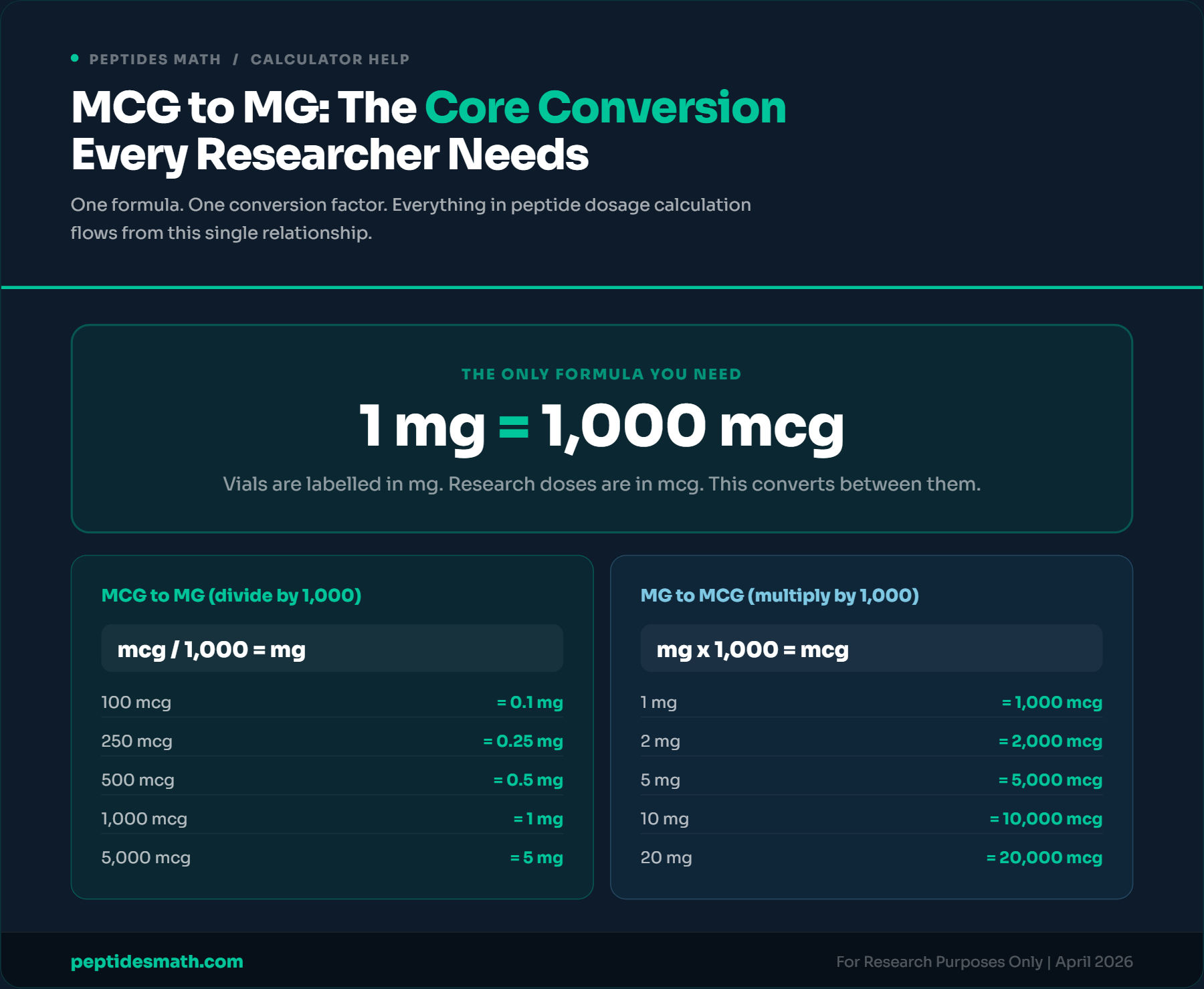
1 mg = 1,000 mcg
This single conversion factor underpins every peptide dosage calculation. Your vial contains mg. Your dose is in mcg. The conversion connects them.
Why Peptide Doses Are Expressed in Micrograms
Peptide compounds are biologically active in very small quantities. Most research protocols use doses in the range of 100 mcg to 1,000 mcg per application. Expressing these as milligrams would require decimal fractions like 0.1mg or 0.5mg, which are prone to reading errors.
Using micrograms keeps the numbers as whole numbers or simple fractions, reducing the risk of decimal-point errors in your calculations. A dose of 250 mcg is easier to work with than 0.25mg, even though they are identical values.
Why Vials are Labeled in Milligrams
Peptide vials contain relatively large total amounts compared to individual doses. A standard vial might contain 5mg or 10mg of the compound. Expressing these as 5,000 mcg or 10,000 mcg would be less intuitive for labeling and ordering purposes. So manufacturers use milligrams on the vial label, and researchers convert to micrograms when calculating individual doses.
How to Convert MCG to MG
Converting micrograms to milligrams requires one step: divide by 1,000.
MCG to MG formula: mg = mcg divided by 1,000
Worked Examples
100mcg to mg: 100 divided by 1,000 | = 0.1mg
200mcg to mg: 200 divided by 1,000 | = 0.2mg
250mcg to mg: 250 divided by 1,000 | = 0.25mg
300mcg to mg: 300 divided by 1,000 | = 0.3mg
500mcg to mg: 500 divided by 1,000 | = 0.5mg
750mcg to mg: 750 divided by 1,000 | = 0.75mg
1,000mcg to mg: 1,000 divided by 1,000 | = 1mg
1,500mcg to mg: 1,500 divided by 1,000 | = 1.5mg
2,000mcg to mg: 2,000 divided by 1,000 | = 2mg
2,500mcg to mg: 2,500 divided by 1,000 | = 2.5mg
5,000mcg to mg: 5,000 divided by 1,000 | = 5mg
10,000mcg to mg: 10,000 divided by 1,000 | = 10mg
How to Convert MG to MCG
Converting milligrams to micrograms requires one step: multiply by 1,000.
MG to MCG formula: mcg = mg multiplied by 1,000
1mg to mcg: 1 multiplied by 1,000 | = 1,000mcg
2mg to mcg: 2 multiplied by 1,000 | = 2,000mcg
2.5mg to mcg: 2.5 multiplied by 1,000 | = 2,500mcg
5mg to mcg: 5 multiplied by 1,000 | = 5,000mcg
10mg to mcg: 10 multiplied by 1,000 | = 10,000mcg
15mg to mcg: 15 multiplied by 1,000 | = 15,000mcg
20mg to mcg: 20 multiplied by 1,000 | = 20,000mcg
Calculator: Free MCG to MG Calculator
Complete MCG to MG Reference Table for Peptide Research
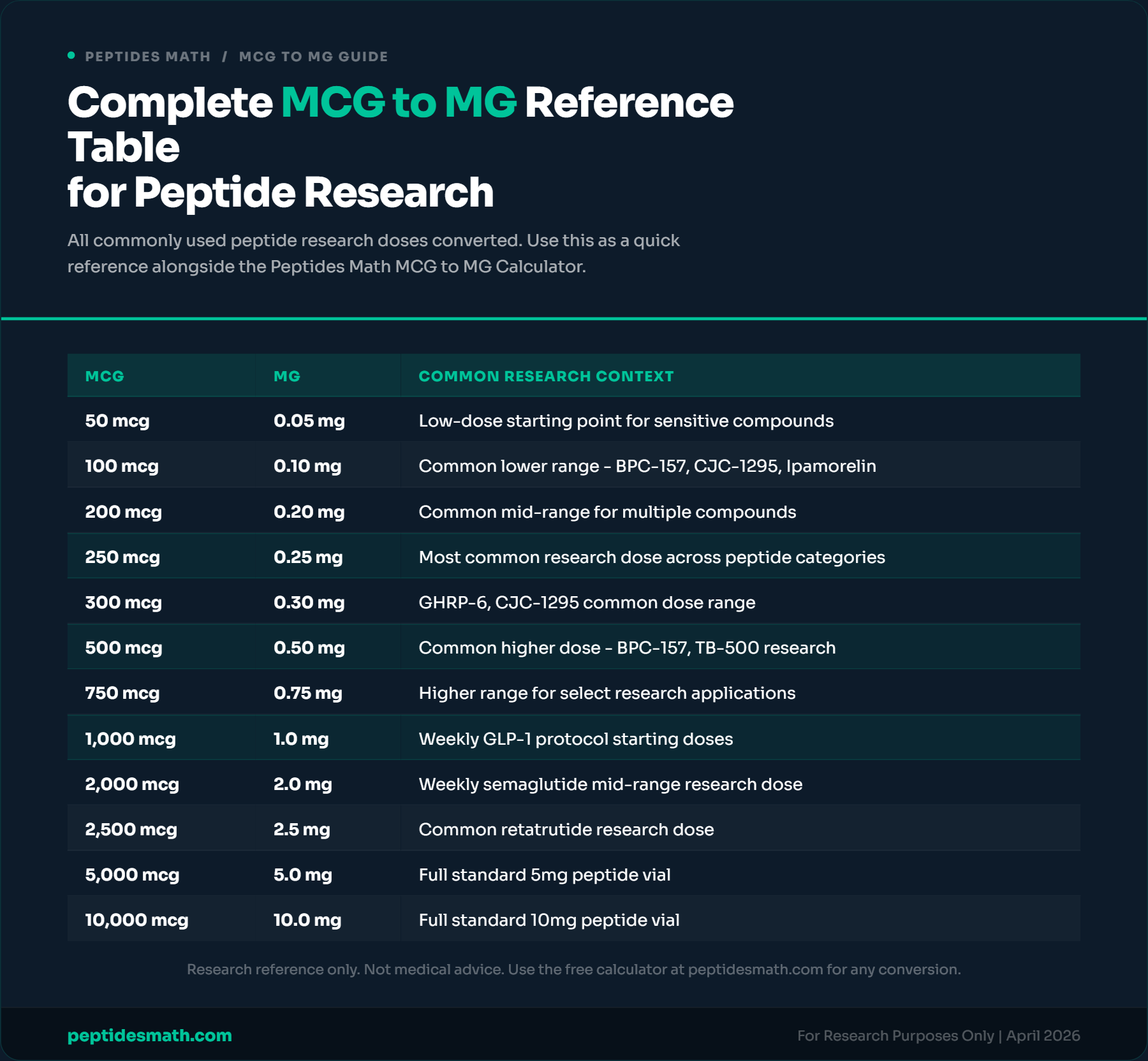
The following table covers the most commonly used peptide research dose values. Use this as a quick reference alongside the MCG to MG calculator.
Where the MCG to MG Conversion Fits in Your Research Workflow
Understanding when and why you use this conversion is as important as knowing the formula itself. The conversion appears at multiple points in the peptide research calculation chain.
Step 1: Converting Your Vial Amount for Concentration Calculation
Your peptide vial is labeled in milligrams. To calculate concentration after reconstitution, you need to convert the vial amount to micrograms first.
Example: You have a 5mg vial. Convert to mcg: 5mg multiplied by 1,000 equals 5,000mcg. If you add 2ml of BAC water, your concentration is 5,000 mcg; 2ml divided by 2ml equals 2,500 mcg per ml.
Step 2: Expressing Your Research Dose in the Right Unit
Research protocols typically express doses in micrograms. Before calculating syringe units, confirm your dose is in mcg. If a protocol states a dose in mg, convert it to mcg by multiplying by 1,000.
Example: A protocol calls for 0.25mg per dose. Convert to mcg: 0.25mg multiplied by 1,000 equals 250mcg. Now you can use this value directly in your syringe unit calculation.
Step 3: Calculating Total Compound Needed for a Research Protocol
When planning how many vials you need for a full research protocol, you work in mcg for the dose calculations and then convert the total back to mg to know how many milligrams to order.
Example: A 30-day protocol uses 250 mcg per application, twice daily. Total mcg needed: 250mcg multiplied by 2 multiplied by 30 equals 15,000mcg. Convert to mg: 15,000mcg divided by 1,000 equals 15mg. You need 3 vials of 5mg each.
Common Research Peptide Doses in Both MCG and MG
The table below shows the most commonly referenced doses from published preclinical research for specific peptide compounds, expressed in both micrograms and milligrams. These values are for research reference only.
BPC-157 Research Doses
Low dose: 250mcg | 0.25mg | Common lower research dose
Mid dose: 500mcg | 0.50mg | Common mid-range research dose
High dose: 1,000mcg | 1.0mg | Higher range used in some studies
CJC-1295 and Ipamorelin
Low dose: 100mcg | 0.10mg | Conservative starting range
Common dose: 200mcg | 0.20mg | Frequently referenced in research
Higher dose: 300mcg | 0.30mg | Used in some combination protocols
Semaglutide (Weekly Research Dose)
Week 1: 250mcg | 0.25mg | Starting range in research protocols
Week 5: 500mcg | 0.50mg | Mid-escalation range
Week 9: 1,000mcg | 1.0mg | Higher research dose range
Week 13: 2,000mcg | 2.0mg | Upper research dose range
Retatrutide (Weekly Research Dose)
Starting: 1,000mcg | 1.0mg | Conservative research starting dose
Mid range: 2,500mcg | 2.5mg | Commonly referenced in studies
Higher range: 4,000mcg | 4.0mg | Upper range in published research
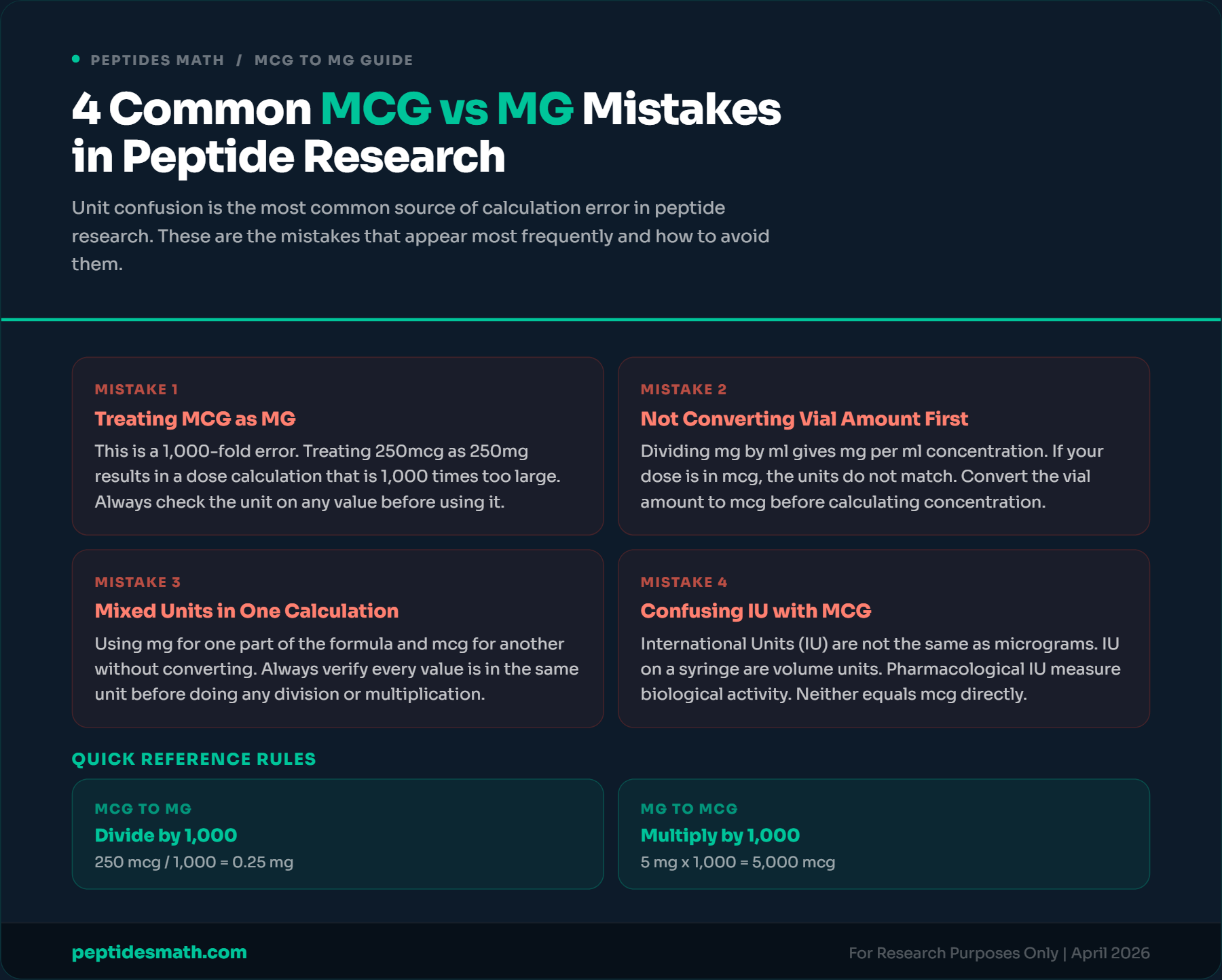
The Most Common MCG to MG Conversion Mistakes in Peptide Research
Unit confusion is responsible for more peptide research calculation errors than any other single factor. These are the most frequent mistakes.
Mistake 1: Treating MCG as MG
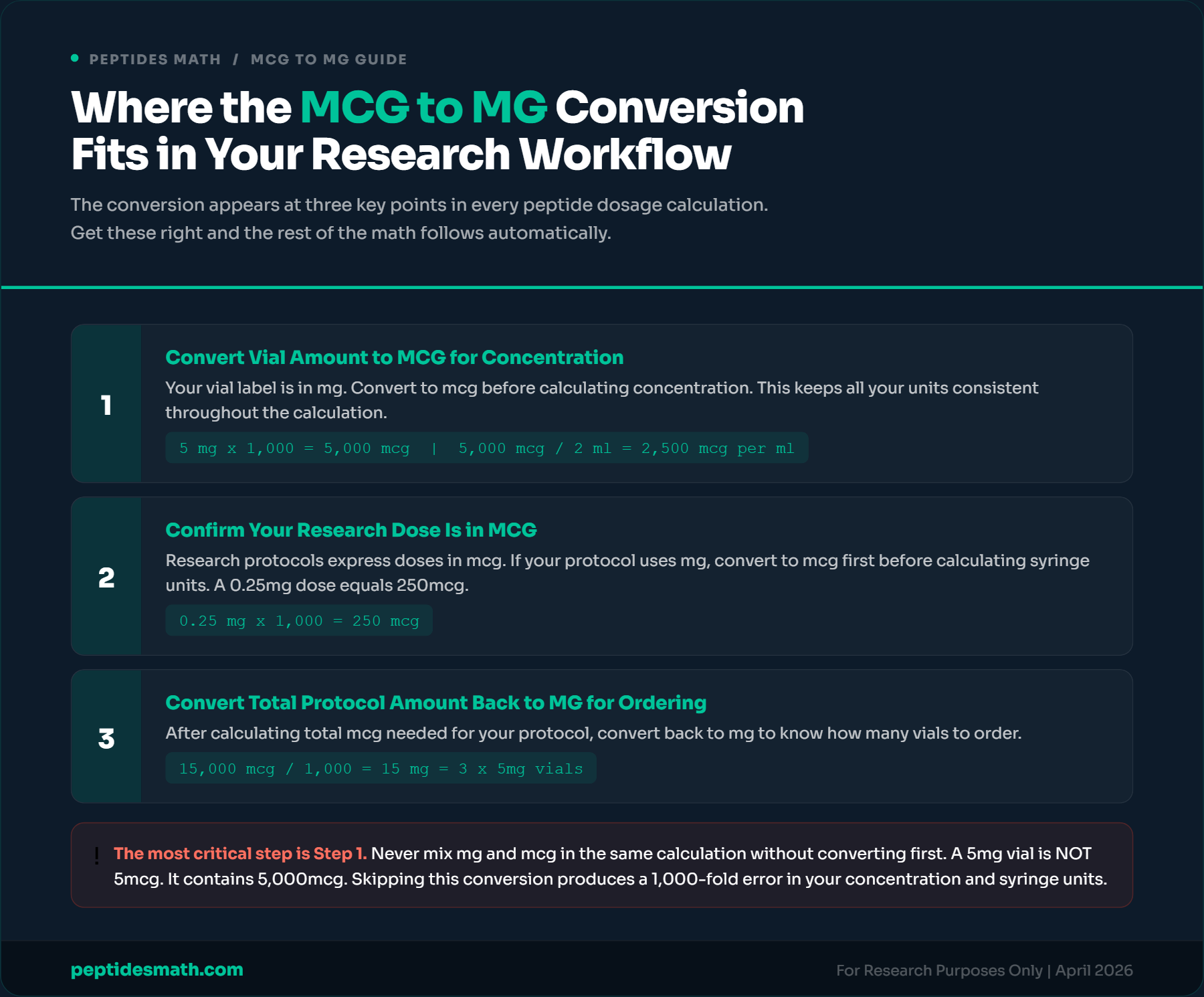
This is a 1,000-fold error. If you treat a 250mcg dose as though it were 250mg, you would calculate a syringe volume 1,000 times too large. If you treat 5mg as 5mcg, your concentration calculation will be 1,000 times too small.
Always check: is this value in mg or mcg? The vial label is in mg. The dose in a research protocol is almost always in mcg.
Mistake 2: Forgetting to Convert the Vial Amount Before Calculating Concentration
The concentration formula requires consistent units. If you divide the vial amount in mg by the water volume in ml, you get mg per ml. If your dose is in mcg, you then need to convert the concentration before dividing. The cleanest approach is to convert the vial amount to mcg first, before doing any other calculation.
Example of the error: 5mg vial, 2ml water, 250mcg dose. Wrong approach: 5 divided by 2 equals 2.5 mg/mL. Then 250 divided by 2.5 equals 100. This gives the wrong syringe units because the units are inconsistent. Correct approach: 5,000 mcg divided by 2 mL equals 2,500 mcg per mL. Then 250 divided by 2,500 equals 0.1ml equals 10 syringe units.
Mistake 3: Not Checking Units When Reading a Research Protocol
Published research papers and online protocols may express doses in different units depending on the source. Some use mg per kg body weight, others use mcg per kg, and others just use a flat mcg dose. Always note the unit before using the number.
Mistake 4: IU Confusion
International Units (IU) are a separate measurement system used for some compounds, including human growth hormone. IU values cannot be directly converted to mg or mcg without a compound-specific conversion factor. Do not confuse IU markings on an insulin syringe (which are just volume units) with pharmacological International Units (which measure biological activity).
Using the Peptides Math MCG to MG Calculator
The Peptides Math MCG to MG Calculator handles the conversion instantly for any value you enter. It also converts in both directions: mcg to mg and mg to mcg.
- Enter your value in the mcg field to get the equivalent in mg
- Enter your value in the mg field to get the equivalent in mcg
- The calculator updates in real time as you type
- Use the result directly in your dosage calculation workflow
The calculator is free, requires no account, and works on any device. For more complex calculations involving vial strength, BAC water volume, and syringe units, use the main Peptide Dosage Calculator, which handles the full three-step calculation automatically.
FAQ: MCG to MG Peptide Conversion
How many mcg are in 1mg?
There are 1,000 micrograms (mcg) in 1 milligram (mg). This is the single most important conversion in peptide research. 1mg equals 1,000mcg. 0.5mg equals 500mcg. 0.25mg equals 250mcg.
How do I convert 250mcg to mg?
Divide 250 by 1,000. The answer is 0.25mg. So 250mcg equals 0.25mg. Both values represent exactly the same amount of compound.
How do I convert 500mcg to mg?
Divide 500 by 1,000. The answer is 0.5mg. So 500mcg equals 0.5mg.
How do I convert 100mcg to mg?
Divide 100 by 1,000. The answer is 0.1mg. So 100mcg equals 0.1mg.
How do I convert 5mg to mcg?
Multiply 5 by 1,000. The answer is 5,000mcg. A 5mg peptide vial contains 5,000 mcg of the compound.
How do I convert 10mg to mcg?
Multiply 10 by 1,000. The answer is 10,000mcg. A 10mg peptide vial contains 10,000mcg of compound.
What is the difference between mcg and mg in peptide dosing?
Milligrams (mg) is the unit used on peptide vial labels. Micrograms (mcg) is the unit used to express individual research doses. Since 1mg equals 1,000 mcg, you must convert between the two when calculating concentrations and syringe units. Confusing mg with mcg results in a 1,000-fold calculation error.
Why are peptide doses expressed in mcg instead of mg?
Most research peptide doses are smaller than 1mg. Expressing them in micrograms keeps the numbers whole. For example, 250mcg is easier to work with than 0.25mg, even though they are the same amount. Using whole numbers reduces the risk of decimal point errors in your calculations.
Related Research Tools on Peptides Math
- MCG to MG Calculator
- MG to MCG Calculator
- Peptide Dosage Calculator
- Peptide Reconstitution Calculator
- BAC Water Calculator
- IU to MCG Converter
- BPC-157 Dosage Calculator
- Semaglutide Dosage Calculator